
EGO — Why Your “I” Is Not Your Enemy
EGO — Why Your “I” Is Not Your Enemy
What Freud actually meant by the ego, why the command to “kill your ego” may lead nowhere, and what freedom could look like beyond contempt for yourself.
There is a remarkable thing people sometimes say, often at the precise moment when they are most proud of their spiritual progress: “I have overcome my ego.”
Occasionally this is followed by a lecture on how blind, shallow or unconscious everyone else still is.
You hesitate to disagree. Not because the claim must be true, but because it unintentionally demonstrates something: the feeling of having risen above others can become a new identity of its own.
Perhaps the ego is not quite so easy to dispose of. Perhaps we are so afraid of it because we have been asking the wrong question.
What if the problem is not the ego, but our need to turn our own sense of self into an enemy?
I. The Crime of an Ordinary Word
Ego is, to begin with, simply the Latin word for I. In everyday speech, however, it has become a container for nearly everything we dislike in other people: vanity, greed, selfishness, pride, possessiveness and an exaggerated sensitivity to criticism.
“He has a huge ego” rarely means “He possesses a well-organised capacity for reality testing.” It means that this person considers himself more important than everyone else.
As everyday criticism, that may be understandable. But when people say this while invoking Sigmund Freud, Carl Gustav Jung or Buddhist teachings, they run together concepts that answer very different questions.
Freud's ego is not synonymous with selfishness. In The Ego and the Id (1923), particularly Chapters II, III and V, he examines its role within a structural model that also includes the id and the superego. Among other functions, the ego mediates between internal impulses, demands or prohibitions, and the conditions of the outside world.
These are concepts in psychoanalytic theory, not separate organs that can be located in the body. Individual claims must be tested rather than treating Freud's model as a complete account of neuroscience.
But the basic confusion comes earlier. To equate the ego with egotism is to mistake a condition of agency for one possible abuse of it.
II. The Office in Your Head
Imagine a city. There is hunger, hope, exhaustion, fear, planning, old obligations and new temptations. All of it, at once. Some capacity must establish priorities, make decisions possible and prevent the city's direction from changing with every passing impulse.
This is not an exact map of Freud's psychic apparatus. It is a way of grasping the question that interests him: how can a human being navigate a world in which desire does not automatically coincide with reality's demands?
You are hungry and would like to eat immediately, but you are working and have to wait. You have been hurt and want to send a vicious message, yet another part of your thinking recognises that doing so may only make the conflict worse. You want everyone's approval and also know that you have to draw a boundary.
What a peculiar freedom it would be to become helpless before every new impulse.
That is why we should hesitate before treating the ego as an intruder. The ability to establish boundaries, remember aims and make decisions in relation to the world is not a moral disease.
Freud did not idealise the ego as an all-powerful sovereign. His model also emphasises its dependencies and limited insight. That is precisely what makes it interesting: we need some form of self-organisation, but cannot trust it blindly.
III. Jung Asks a Different Question
Carl Gustav Jung uses the term ego differently within analytical psychology. In Aion (1951), Chapter I, “The Ego,” he describes it as the reference point of conscious contents: a centre within the field of consciousness. For Jung, the Self refers to a more comprehensive conception of psychic wholeness.
That does not mean the whole personality can be reduced to the conscious ego. Nor does it mean that anyone with a strong self-image has therefore attained profound self-knowledge.
Here another distinction matters. Jung's persona describes the social outward face we present to others; the shadow points to aspects of personality that sit uneasily with our conscious picture of ourselves.
Even these few distinctions show why it is wrong to use ego, persona, shadow and Self as interchangeable labels.
We may criticise these models. But first we must understand the different questions they attempt to answer.
Someone claiming to have overcome the ego ought to say what they mean. Selfishness? The conscious I? The impulse to compare yourself with everyone else? Attachment to a fixed identity? The hunger for recognition?
Without that distinction, a spiritual thesis becomes nothing more than an impressive-sounding sentence.
IV. The Buddha Was Not Fighting Freud's Ego
A related problem arises when Western accounts of the ego are blended with the Buddhist teaching of not-self.
In the early Buddhist Anattalakkhaṇa Sutta (Saṃyutta Nikāya 22.59), five aggregates are considered—form or body, feeling, perception, mental formations and consciousness. We can easily mistake these changing aspects of experience for a lasting self under our full control. The text asks whether something impermanent and not fully governable should be claimed as “my self.”
This does not mean that people have no experiences, no responsibilities, or no need to make reasonable decisions. Neither is it a direct refutation of Freud's twentieth-century structural model. The teachings emerged in different historical periods and approach what we call the “I” through different questions.
Two words that sit close together in a modern translation do not create one universal doctrine.
The useful bridge is elsewhere: for different reasons, both traditions can prompt us to question the apparently self-evident authority of our own self-image.
But neither has established that a personified “ego entity” must be removed from inside the head.
V. The Person No Longer Allowed to Like Themselves
Kill your ego sounds like a heroic promise of liberation. But what happens to someone taught to suspect every personal wish?
They want to succeed: ego.
They want recognition: ego.
They say no: ego.
They defend their work: ego.
They feel hurt: apparently that is ego too.
Soon an ideal of self-transcendence may turn into a surprisingly cruel form of self-surveillance. Anything resembling personal interest is treated as evidence of spiritual failure.
This is not an inevitable consequence of Buddhist practice or Jungian psychology. It is one possible distortion in popular self-help rhetoric. And its human consequences matter: a person who no longer believes they have a right to needs does not automatically become freer. They may become easier to manipulate.
Imagine someone saying, “If you were truly free of your ego, you would not disagree with me.”
What began as a path to self-knowledge has become a demand for obedience. The abolition of the ego becomes a convenient excuse for denying someone else the right to boundaries.
Genuine self-knowledge would have to allow the opposite: the ability to examine one's motives without treating oneself as worthless.
VI. But What About the Narcissist?
There are, of course, people who belittle others to feel superior. Vanity can hurt. So can the pursuit of power, disregard for other people and deliberate deception. Such behaviour must remain open to criticism.
But precision matters especially here.
“Big ego” is a colloquial judgment. Narcissism may describe a personality trait, a dimension studied in psychological research or, under particular criteria, a clinical diagnosis. These are not interchangeable categories.
A self-confident person is not automatically narcissistic. A shy person is not automatically selfless. Someone may project modesty in public and obsess over admiration in private. Another person may be visibly proud of an achievement without believing themselves superior to everyone else.
We therefore need fewer instant character labels and better questions: What did the person actually do? What were the consequences for others? Is the behaviour repeated? Can they receive criticism? Do they accept responsibility?
Then moral language becomes an inquiry into conduct instead of a box of insults.
VII. The Strange Business of Self-Overcoming
There is a market for the idea that our ordinary self is inadequate. We are told to cleanse it, dissolve it, subdue it, transform it—and finally replace it with an upgraded version.
Someone selling that promise may also happen to offer the appropriate course, retreat or set of instructions.
That does not mean that every spiritual school or personal-development course is dishonest. Some practices help people think more clearly about their lives. But the underlying logic still deserves scrutiny:
Who benefits if you come to regard ordinary humanity as a permanent defect?
A person fundamentally dissatisfied with themselves may spend a lifetime searching for the next repair. But not every moment of shame signals a problem requiring spiritual intervention. Sometimes what is needed is a boundary, an admission of error, a conversation or some rest—not another supposed stage of enlightenment.
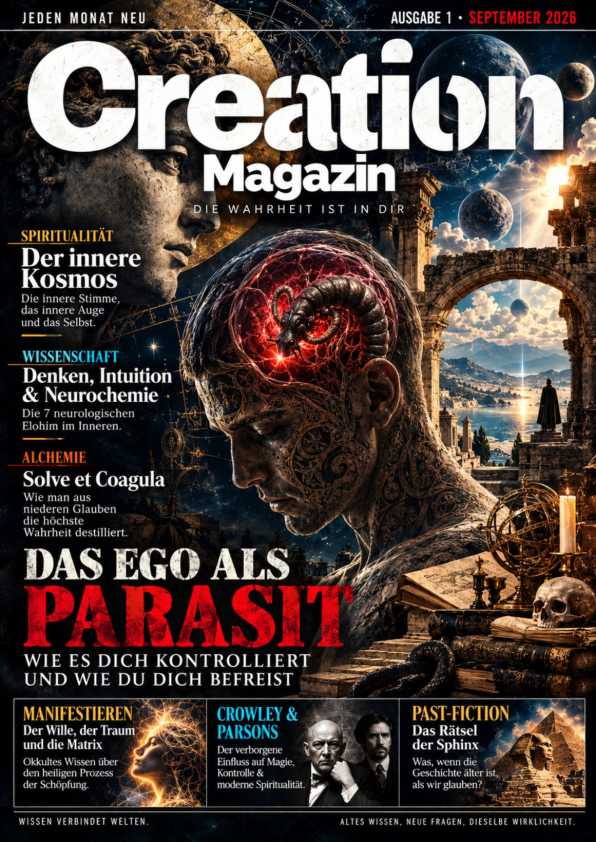
CREATION must not turn the search for self-knowledge into a new hierarchy of its own: the awakened on one side, ordinary people on the other. That would simply be another social role wearing a spiritual label.
VIII. The CREATION Dialectic: The Tool and Its Owner
Let us try a more precise distinction.
A person has an image of themselves and needs ways of acting through it. That image can help them keep promises, take responsibility and connect decisions over time. As a working model, it is useful.
But models can harden.
“I often behave this way” becomes “This is simply who I am.”
A useful memory turns into a prohibition against change. We are no longer defending our values but the habit of describing ourselves in one particular way.
The familiar response is: destroy the ego.
The more interesting one may be: keep the ability to say “I,” but do not confuse the word with the whole human being.
The ego is neither a sacred object nor a suitable enemy. It is a tool for orientation, one that must remain open to correction through reality, relationships and new experience.
This is CREATION's editorial interpretation—not a hidden common doctrine shared by Freud, Jung and the Buddha. It offers one important possibility: change without self-hatred.
IX. A Small Experiment You Cannot Fail
Recall a situation in which you defended yourself. Perhaps the other person's objection was unfair. Perhaps it contained an uncomfortable truth.
Write three sentences:
1. What was said?
2. What part of it might be true?
3. What boundary am I nevertheless entitled to keep?
Now observe whether you can avoid two extremes: immediately treating the other person as an enemy, or hastily declaring yourself the entire problem.
This is not an invitation to give way in every conflict, nor to suppress every feeling. A workable self-image ought to let us consider criticism while also allowing us to disagree for good reasons.
Perhaps a more mature form of ego becomes visible precisely here: it does not need to be infallible in order to act.
X. The Ego's Final Triumph
Return to the person who proudly announces that they have overcome their ego.
Perhaps they mean something worthwhile. Perhaps they have learned to compare themselves less, take other people seriously and stop letting every slight determine their actions. That deserves recognition.
Or perhaps they mean that criticism no longer applies to them.
In that case the problem has not disappeared. It has merely found a better uniform.
A more difficult freedom may consist in permitting both truths: we need an “I” with which to organise our lives, and we must recognise that this organisation can never contain the entire person.
You do not have to kill your ego in order to grow. Perhaps you only have to stop mistaking it for everything you are.
Sources and Conceptual Distinctions
• Sigmund Freud, The Ego and the Id (1923), especially Chapters II, III and V on the place and dependencies of the ego. Historical Freud editions and text archives, including material associated with the International Psychoanalytic University.
• C. G. Jung, Aion (1951), Chapter I, “The Ego,” and the chapters on the Self. Jung's model is not an identical reproduction of Freud's structural theory.
• The Anattalakkhaṇa Sutta, Saṃyutta Nikāya 22.59, on the five aggregates and not-self. Text and English translation by Bhikkhu Sujato at SuttaCentral.
CREATION editorial interpretation. The critique of popular “ego-killing” rhetoric, the city and tool metaphors, and the conclusion about a corrigible self-image are philosophical thought models. They are not presented as an empirically proven psychological theory or an identical doctrine shared by three traditions. This article does not replace psychotherapy or individual professional advice.
Further Reading in CREATION
• Persona — The role that becomes too narrow: https://www.creationmagazin.com/en/beitrag/persona-the-mask-that-saves-you
• Shadow — The stranger you fight in others: https://www.creationmagazin.com/en/beitrag/shadow-the-stranger-you-fight-in-others
• Self — More than the conscious I (German): https://www.creationmagazin.com/beitrag/creation-glossar-selbst-definition-schulen-quellen
• Anatta — The Buddhist teaching of not-self (German): https://www.creationmagazin.com/beitrag/creation-glossar-anatta-definition-schulen-quellen



Comments