
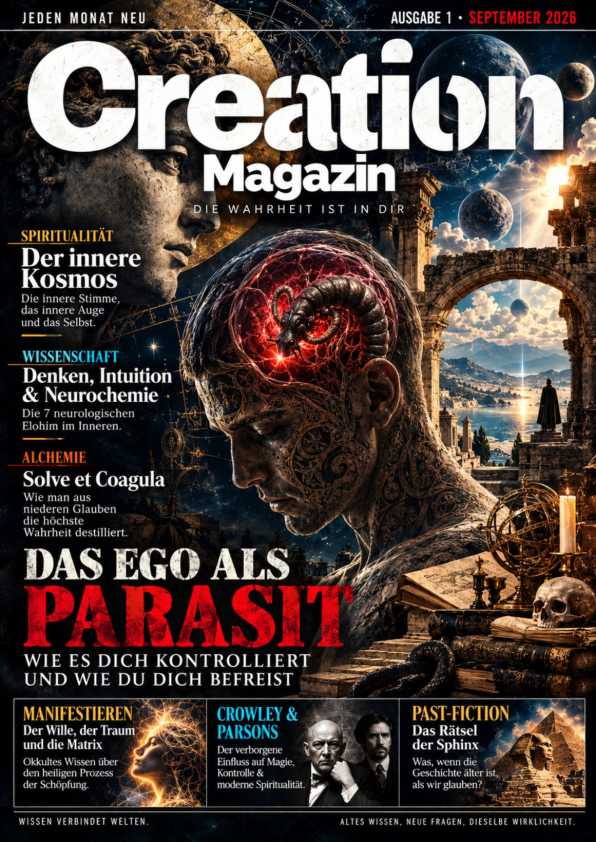
TRUE WILL — Who Decided What You Want?
TRUE WILL — Who Decided What You Want?
On a sentence by Aleister Crowley, Schopenhauer's objection, and the most dangerous confusion on the road to freedom: mistaking a desire for the truth about oneself.
It is easy to speak of freedom when freedom costs nothing.
Imagine someone preparing to resign from a job. For years, they have said: This profession isn't my life. They want to write, to build something of their own, to make their own decisions. One morning the resignation letter lies open on the screen. The cursor blinks. One click, and a desire becomes an action.
But at precisely that moment, the problem begins.
Do they really want to leave? Or do they simply want to stop feeling that they have to stay? Do they long for another life—or for the experience, at last, of having made an enormous decision? And whose voice is speaking: conviction, exhaustion, pride, or the fear of wasting another ten years?
We often treat desires as evidence of identity. Whatever draws us powerfully must belong to our deepest self. Whatever feels like release must be freedom. But a desire can feel entirely our own and still arise from conditions we never chose.
Here two thinkers meet across more than a century and a gulf of worldviews: Arthur Schopenhauer and Aleister Crowley. One challenges the freedom of individual willing. The other places the discovery and fulfilment of True Will at the centre of a religious-philosophical teaching.
Both force us to confront the same uncomfortable question: Who is doing the willing when you say, “I want”?
I. The Most Dangerous Sentence in Modern Esotericism
“Do what thou wilt shall be the whole of the Law.”
The sentence appears in Liber AL vel Legis, or The Book of the Law, I:40—a text Crowley said he received in extraordinary circumstances in 1904. That account of its origin belongs to Thelemic tradition. It is not evidence that a superhuman entity actually spoke.
Few sentences are easier to misunderstand.
Do what you want. Indulge yourself. Shake off every obligation. Your desire is sacred, and anyone who stands in your way simply fails to understand your truth.
Except that Crowley himself does not make it so simple.
In Liber II: The Message of the Master Therion, first published in The Equinox III(1) in 1919, he explicitly distinguishes the law from doing whatever happens to please us. He speaks of finding a direction that is one's own and that makes a claim upon the whole of one's life. Will is to be concentrated, not scattered among every new distraction.
That is a remarkable contradiction of the popular fantasy of freedom. What sounds like limitless permission becomes an exacting demand.
Not: I may do anything. Rather: I must discern what I am actually to do—and stop continually evading it.
In Liber AL I:42–44, the idea is linked to will purified of attachment to results. In I:57, love and will are joined in another of the text's famous formulations. The setting is religious and magical, not an early edition of modern career advice. That is precisely why the argument deserves more than the treatment of an inspirational calendar slogan.
II. The Stars That Supposedly Never Collide
Crowley offers a powerful image: every person is a star. Every star has its own orbit. In the Thelemic picture articulated in Liber II, people following their True Will would not need to collide destructively with one another.
It is beautiful. Almost too beautiful.
Because in actual lives, people want incompatible things. Two candidates want the same position. A parent needs support while an adult child wants to move far away. One business partner wants security; the other wants to stake everything on a risky idea.
Are these conflicts merely proof that at least one person has not yet discovered their True Will?
That would be a convenient answer—and a dangerous one. It could turn every disagreement into evidence of spiritual failure. We would no longer have to negotiate, acknowledge tragic conflicts of interest, or take other people's priorities seriously. Whoever claimed most loudly to be following a higher Will would acquire a position apparently beyond challenge.
Crowley's own text Duty complicates the picture. He expressly warns against interfering with another person's will. Yet the same writing also contains harsh, from a contemporary perspective deeply troubling claims about weakness, pity, and social order. Those tensions cannot simply be hidden behind a harmonious metaphor of the stars.
This is where a serious CREATION reading must become uncomfortable: claiming a higher Will does not exempt anyone from answering for what their actions do to other people.
The existence of a person's “true orbit” is an interpretation within Thelema. It is not an established law of human relationships.
III. Schopenhauer Walks into the Room and Asks One Question
Long before Crowley proclaimed his law of Will, Arthur Schopenhauer had formulated a different difficulty.
In On the Freedom of the Human Will, the essay that won a prize in 1839 and was subsequently published in The Two Fundamental Problems of Ethics, he carefully distinguishes freedom to act from freedom of willing itself.
Being able to open a door when you want to leave is one thing. Explaining why you want to leave in the first place—and whether you could have wanted differently under precisely the same inner and outer conditions—is another.
His challenge can be rendered in English as: Can you also will what you will?
Every apparently sovereign decision sends us back another level. If I will myself to want something different, where does this second will come from? And the third?
Within his philosophical system, Schopenhauer argues that particular acts of willing arise from the relation between character and motives. He rejects the picture of a wholly undetermined choice emerging without grounds. That is a philosophical argument, not a fact conclusively demonstrated by a single experiment.
The World as Will and Representation goes further. In Book II, particularly section 18, Schopenhauer connects the immediate experience of one's own body with his metaphysics of Will. For him, Will is not simply a life goal, professional ambition, or unusually authentic personal decision. It names a fundamental principle within his interpretation of reality, expressed among other things in human striving.
The shared word must not fool us. Crowley's True Will and Schopenhauer's metaphysical Will are not two names for one doctrine.
Their difference is precisely what makes the confrontation worth having.
IV. Two Answers That Wound One Another
Crowley's challenge might be put like this: Discover what corresponds to your nature, then shape your life around it.
Schopenhauer's objection might sound like this: What you experience as your nature has causes; you cannot simply escape them by deciding once more.
One thought gives us direction. The other destroys our certainty about ourselves.
Crowley's language grants Will something close to royal dignity. Schopenhauer makes us wonder whether the king commands his own throne at all.
Yet Schopenhauer's philosophy is not reducible to resignation. In Book IV of The World as Will and Representation, he distinguishes affirmation from denial of the will-to-live. In Crowley, by contrast, the discovery and enactment of one's path becomes a central task.
One philosophy finds a problem in ceaseless striving; the other finds a calling in striving rightly directed. Should a person follow Will? See through it? Or free themselves from some part of willing?
There is no comfortable single answer that reconciles these positions. Melt them together and the real philosophical tension disappears.
And now it becomes personal.
If your hunger for success grows out of terror at being insignificant, is success your True Will—or an attempt to escape an old fear?
If you are always available to others because you only know how to receive love by being useful, is your helpfulness an expression of freedom—or of dependence?
And if you throw everything away just to prove how free you are: to whom, exactly, are you trying to prove it?
V. The Trap of the Great Calling
Our age has made the search for one's own path into another obligation.
Find your calling. Live your passion. Discover your purpose. Don't merely work—fulfil yourself. Don't merely achieve something—be extraordinary.
A promise that could have been liberating quietly turns into a further social demand.
Someone who wants a quiet, unremarkable life is easily treated as a person wasting their potential. Someone who does not feel passionate every day begins to doubt their direction. Someone who fails imagines they have misread the hidden plan of their own existence.
But what if the demand to find your True Will is itself just another role you are expected to perform?
Perhaps your task is not to become exceptional. Perhaps you honestly want to care for somebody, master a craft, solve a problem, think in peace, or live a life that does not need to be explained in public every day.
The significance of a decision cannot reliably be measured by how loudly it announces itself.
This is where True Will meets CREATION's account of the persona. What feels like an inner vocation can become an outward mask. And that mask can become a prison when every change of direction looks like betrayal of the supposedly true self.
VI. The Freedom Not Everyone Can Afford
It would be easy to call out to the person staring at the resignation letter: Be brave. Follow your Will.
But perhaps they have children, debts, or people who depend on their support. Perhaps the job is bad, yet an alternative is not financially viable. Perhaps the right next step is not resignation but six months of preparation.
Anyone who speaks of freedom while ignoring material reality risks mistaking philosophical elevation for having no ground beneath their feet.
A Will does not become false merely because fulfilling it requires conditions. And a decision is not cowardly merely because it takes responsibility seriously.
Of course, responsibility can become an excuse for never changing anything. Concern for others may be genuine—and it may also shelter a fear of risk. No safe formula will decide between those possibilities for us.
That is why Will requires judgment.
A mature Will is not merely strong enough to begin. It is attentive enough not to erase the consequences from the story it tells about itself.
VII. CREATION: Desire, Will, and Direction
From this disagreement we can develop a working model of our own. Not a quotation from Crowley, not a proposition of Schopenhauer's, and not a scientifically established division into three parts—but a philosophical instrument.
Desire says: I would like something to change.
It is a signal, not yet an argument.
Will says: I choose to do something for this change and to bear a cost.
It appears in action and has to prove itself against resistance.
Direction asks: What kind of life and responsibility emerge from repeated decisions?
Direction remains open to examination and can change with new understanding.
The point is not that desires are bad and Will is good. Desires matter. They reveal needs, longings, and conflicts. But they are not commands immune to challenge.
Nor does suffering prove that a direction is right. Someone pursuing a false conviction can show extraordinary perseverance. Willingness to sacrifice is no substitute for testing a belief.
Perhaps, then, the measure of a path is neither its intensity nor its difficulty, but a combination of clarity, consistency, willingness to correct oneself, and attention to reality.
That sounds less mystical than a secret cosmic destiny.
It takes the human being more seriously.
VIII. Four Tests for a Supposedly True Will
Choose a decision that has occupied you for a long time. Write down the sentence: I want ...
Now examine it four times.
1. Origin. Where did this desire come from? When did it first appear? Would I still want it if nobody knew about it, admired it, or disapproved of it?
2. Cost. Am I prepared to bear the ordinary, exhausting parts of this path—not merely imagine the glory of its outcome? What costs would fall on other people as well?
3. Counterargument. Who could reasonably disagree with me without trying to diminish me? What would be genuinely strong about their objection?
4. Capacity to revise. What would I have to learn in order to reconsider my decision? If the answer is nothing, perhaps I have not found a direction at all. Perhaps I have sealed a belief against every possible test.
This exercise will not disclose a divine plan. Nor is it a psychological test with a scientifically validated rate of accuracy. It can do something harder: make visible the difference between the feeling of certainty and the reasons behind a decision.
IX. A Will That Is Allowed to Contradict Itself
Perhaps the hardest part of genuine self-determination is not defending your path against other people's expectations.
Perhaps it is admitting, later on, that you were mistaken about that path.
We like to believe in a fixed inner core, a mission that never changes. Yet a human being learns and grows old. People enter their life; others leave it. Experience changes what matters.
The possibility of revision does not make every decision arbitrary. Quite the opposite. Only someone capable of admitting error takes a decision seriously enough to measure it against reality.
A Will that is never allowed to be mistaken becomes ideology. A Will that holds to nothing at all disintegrates into impulses.
Between them lies a more difficult freedom: to decide without proclaiming oneself infallible.
The confrontation between Crowley and Schopenhauer does not end in an artificial compromise. Crowley's Thelema remains a distinctive religious philosophy. Schopenhauer's analysis remains an independent metaphysical and ethical system.
CREATION draws another, explicitly editorial consequence from their encounter:
Not every desire is your truth. Not every inward certainty is your destiny. And not every correction means that you have betrayed your path.
X. The Click
Return to the person sitting at the desk.
Perhaps they send the resignation letter. Perhaps they open a spreadsheet instead, calculate what is possible, and begin preparing the transition. Perhaps they discover that the job is not the problem at all, but the fear of disappointing the people around them. Or perhaps the dream has less to do with writing than with finally being seen.
None of these answers can be proved by the intensity of a feeling.
But something has changed. They no longer ask only how badly they want a particular outcome. They ask why they want it, what responsibility it entails, and what reality their vision will have to withstand.
Perhaps that is not True Will in Crowley's sense. Perhaps Schopenhauer himself would have challenged the freedom involved.
For someone trying to shape a life consciously, it may nevertheless be the decisive beginning.
Freedom does not begin by declaring every desire true. It begins when you take your own Will seriously enough to disagree with it.
Sources and Historical Context
Primary Texts
1. Aleister Crowley, Liber AL vel Legis / The Book of the Law, Book I, verses 3, 40–44 and 57 (1904 according to Crowley's account of its origin). Text available through O.T.O. Italia. Claims about supernatural dictation belong to Thelemic tradition.
2. Aleister Crowley, Liber II: The Message of the Master Therion, first published in The Equinox III(1), 1919. Important for the distinction between True Will and momentary pleasure and for the metaphor of the stars. Transcriptions available through the Hermetic Library and the Internet Sacred Text Archive.
3. Aleister Crowley, Duty: A Note on the Chief Rules of Practical Conduct, surviving in manuscript and transcribed in the O.T.O.'s William E. Heidrick Memorial Library. Contains objections to interfering in another person's will alongside ethically troubling normative passages; cited critically, not endorsed.
4. Arthur Schopenhauer, On the Freedom of the Human Will (Über die Freiheit des menschlichen Willens), prize essay of 1839, later published in The Two Fundamental Problems of Ethics (1841). See especially the opening discussion of definitions and the difference between freedom of action and freedom of willing. German editions and digitised text listings are available through Wikisource.
5. Arthur Schopenhauer, The World as Will and Representation, vol. I, Book II, especially §18, and Book IV on the affirmation and denial of the will-to-live. First edition printed in 1818 with the title year 1819; an English translation of volume I is available through Project Gutenberg.
CREATION's interpretation. Bringing these two concepts of Will into conflict, criticising modern pressures to find a grand calling, distinguishing desire, Will, and direction, and proposing four tests of a decision are CREATION's own philosophical readings. They are not presented as Crowley's doctrine, Schopenhauer's teaching, or a scientifically validated psychological instrument. The opening scene is explicitly fictional.



Comments