
THE EAGLE AND THE LION — Why Changing Perspective Is Not Denying Pain

There is a difference between what happens to us and what we eventually make of it. The difference sounds almost trivial—until the day an ordinary explanation for your own life breaks apart.
Imagine two people who have experienced the same rejection. One carries the encounter for years as evidence of their own inadequacy. The other remembers the humiliation just as clearly, but eventually sees something else in it: a boundary crossed, a lesson in misplaced trust, the beginning of a more deliberate life. The event has not changed. Neither has the pain been erased. What has changed is the story permitted to govern the future.
That distinction is easily corrupted. Tell someone to “look on the bright side” while they are grieving, and you are not offering wisdom; you may simply be refusing to look at what has happened. A philosophy of transformation that cannot bear the sight of suffering is not transformation. It is avoidance with better vocabulary.
The moment between injury and identity
Anger can be an honest first signal. Something mattered. Something was taken, ignored, or betrayed. But anger also offers an identity: the injured person, the righteous witness, the one who will never forget. An emotion that began as a messenger can become a home.
Courage does not require pretending that the injury was harmless. Sometimes courage is an explicit refusal to excuse it. Sometimes it is the decision to act rather than rehearse, to protect a boundary without letting the offender determine the shape of every day that follows.
The paradox is uncomfortable: we may be morally correct about an injustice and still be imprisoned by the way we continue to live with it. Being right does not necessarily make us free.
Gratitude is not an order
When gratitude is used as a command—“be thankful for what happened”—it can become cruel. Nobody owes a grateful response to loss, illness, or abuse. Yet there is another meaning worth defending: gratitude as the capacity to recognize what remains, what was given, and what may still be built. It does not cancel grief. It prevents grief from claiming to be the whole of reality.
The old alchemical image of transformation is helpful here, provided we treat it as an image rather than a scientific explanation. Raw material is not thrown away because it is imperfect. It is worked upon. Likewise, the difficult parts of experience are not made valuable by pain itself. They become meaningful, if they do, through the attention and action brought to them.
Why the stranger sometimes looks familiar
There is another obstacle to seeing clearly: the traits we condemn most fiercely in others can resemble what we refuse to examine in ourselves. Jung's language of the shadow gives this an unsettling name. But self-examination has its own trap. It can turn every disagreement into an accusation that the other person is “projecting.” That is not insight. It is an elegant way of avoiding evidence.
A useful question is not simply “What does this person reveal about me?” It is also “What do I know, and what am I merely assuming?” Wisdom needs both inward scrutiny and the discipline to let reality contradict us.
Practice becomes a way of seeing
No single moment of clarity guarantees a different life. We return to old responses because they are familiar. Repetition does not only train habits; it shapes which possibilities we notice first. To practice patience, discernment, or courage is therefore to prepare the mind for a future moment when there may be no time for a lengthy internal debate.
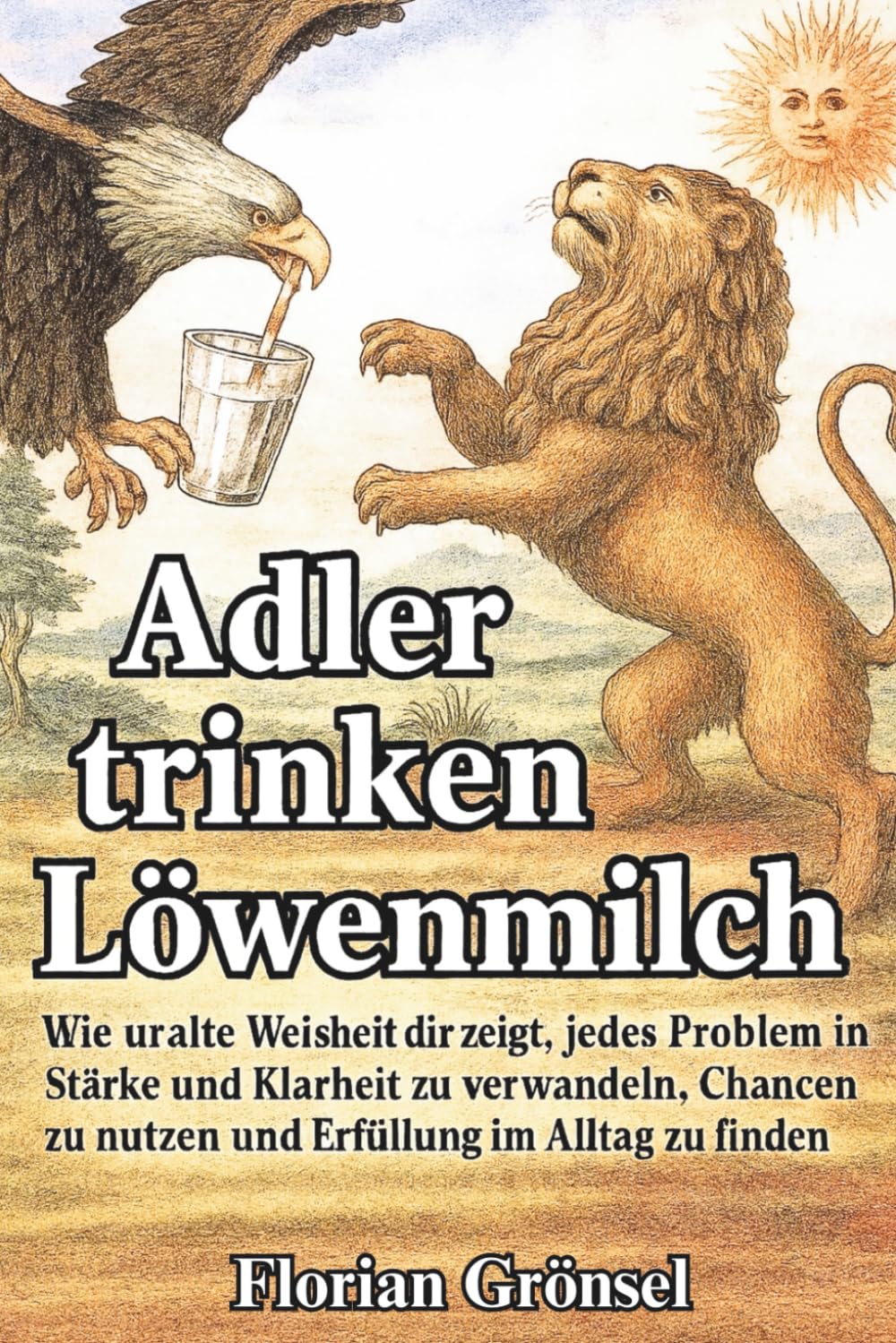
This is where the eagle and the lion become a useful pair of images: the eagle suggests distance and perspective; the lion suggests presence, strength, and the need to act on the ground. Distance without action becomes detachment. Strength without perspective becomes force. We need both.
Twenty-two invitations to question
Florian Grönsel's English book, When Eagles Drink Lion’s Milk, develops these tensions across twenty-two reflections on anger, loss, courage, intuition, self-knowledge, and the ways we repeat ourselves. It is not a formula promising that the world will bend to our wishes. It asks a more demanding question: which part of your life is fact, and which part is the story you have learned to tell about it?
For further exploration in the CREATION knowledge library, read SHADOW — The Stranger You Fight in Other People and TRUE WILL — Who Decided What You Want? The book continues that conversation in a more personal voice.
English Kindle edition available on Amazon.com. Paperback availability may vary by marketplace while Amazon completes its review and distribution.


Comments